Software testing has undergone a seismic shift with the rise of AI and agentic AI. Traditional QA methods are giving way to autonomous, intelligent systems that not only execute tests but also plan, adapt, and learn continuously. Tools like LambdaTest, Testsigma, and agentic AI frameworks are redefining how organizations validate software. The future of testing is autonomous QA, predictive bug detection, and AI agents collaborating seamlessly with DevOps pipelines.– This should come as summary in different color
1. From Manual Testing to AI-Augmented QA
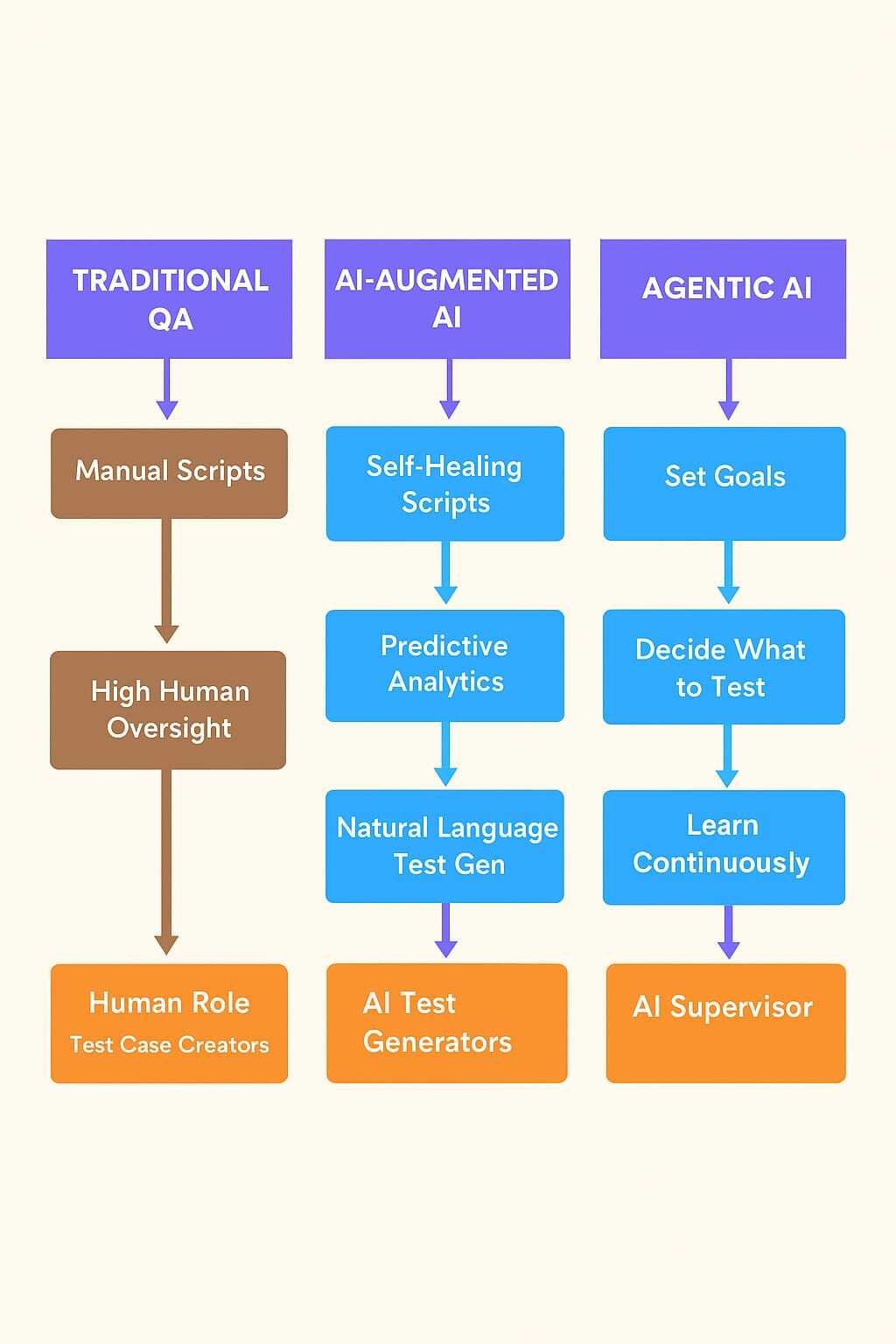
For decades, software testing relied heavily on manual scripts and regression cycles. While automation frameworks like Selenium and JUnit improved efficiency, they still required human oversight for test creation, maintenance, and debugging.
With AI-powered testing, this paradigm shifted:
- Self-healing scripts: AI detects UI changes and adapts test cases automatically.
- Predictive analytics: Bugs are anticipated before they occur, reducing downtime.
- Natural language test generation: Test cases can be written in plain English and converted into executable scripts.
This reduced costs by up to 30–40% compared to manual testing.
2. Rise of Agentic AI in Testing
Agentic AI takes this evolution further. Unlike traditional AI, which reacts to inputs, agentic AI systems act proactively:
- They set goals, break them into steps, and execute autonomously.
- They decide what to test next, based on risk and business impact.
- They learn continuously, improving test coverage over time.
Imagine a banking app rollout:
- Traditional QA: testers write scripts for login, fund transfer, and balance check.
- AI QA: scripts self-heal when UI changes.
- Agentic AI QA: the system autonomously identifies high-risk areas (e.g., fund transfer), generates new test cases, validates security protocols, and reports anomalies—without human intervention.
3. Tools Powering AI & Agentic AI Testing
Several platforms are leading this transformation:
| Tool | Key Capabilities |
|---|---|
| LambdaTest | AI-agentic testing cloud, agent-to-agent validation, conversation flow accuracy |
| Testsigma | Agentic AI testing guide, autonomous test planning & execution |
| ImpactQA | Enterprise-ready agentic AI integration with DevOps pipelines |
| Aspire Systems | Autonomous QA, predictive bug detection, 60% faster release cycles |
These tools act as AI coworkers, reducing human intervention while ensuring higher accuracy and faster delivery.
4. Integration with DevOps & Continuous Testing
Agentic AI thrives in CI/CD pipelines:
- Continuous monitoring: AI agents run tests after every commit.
- Risk-based prioritization: Critical modules are tested first.
- Feedback loops: AI agents communicate with developers, suggesting fixes.
This ensures that software is not just tested but continuously validated in real-time.
5. Challenges & Considerations
While promising, agentic AI testing comes with challenges:
- Trust & transparency: Teams must understand AI decisions.
- Ethical oversight: Preventing bias in test case generation.
- Skill shift: Testers evolve into AI supervisors, guiding agents rather than writing scripts.
6. The Future of Software Testing
Looking ahead:
- Autonomous QA: By 2028, Gartner predicts 15% of daily work decisions will be made by AI agents.
- Predictive bug detection: Systems will flag vulnerabilities before deployment.
- AI-to-AI collaboration: Multiple agents will coordinate testing across environments.
- Human role: Testers will focus on strategy, ethics, and business alignment, while AI handles execution.
Conclusion
Software testing is no longer about executing scripts—it’s about collaborating with intelligent agents. AI brought automation, but agentic AI brings autonomy, adaptability, and foresight. Tools like LambdaTest, Testsigma, and Aspire Systems are already proving that the future of QA is autonomous, predictive, and deeply integrated into DevOps.
The next era of testing will not just validate software—it will anticipate risks, ensure resilience, and accelerate innovation.